Tranquil Spaces: Designing for the Brain with Neuroaesthetics and Biophilic Design
Published by The Biophilic Blueprint | Written by Anjelica Smilovitis

Founder & Principal Designer Deanna Girardot of Tranquil Interiors LLC.
Long before we can name comfort, beauty or unease, our unconscious mind is already responding to the environment around us. Spaces are never neutral—light, texture, proportion and pattern are quietly influencing our physiology, emotions and sense of belonging at every moment according to emerging science. That reality, one interior designer argues, demands greater responsibility in how we design the spaces people inhabit every day.
This unconscious dialogue between people and their surroundings shapes the work of Michigan-based interior designer Deanna Girardot, founder of Tranquil Interiors LLC. The Biophilic Blueprint connected with Deanna via Zoom as snow fell outside her Michigan home, while in Australia the sun was already shining at dawn.
From opposite sides of the world, the conversation turned to biophilic design through a neuroaesthetics and neuroscience lens—exploring how environments can support wellbeing, productivity and rest, or quietly undermine them. Increasingly, the science is catching up in real time, offering evidence for what designers like Deanna have long understood in practice.
“Sometimes, I’m still a little flabbergasted that I’m an interior designer talking about your brain,” Deanna reflects. “I am in a role where I impact environments on a daily basis.” For Deanna, design is not about surface-level styling or following trends. It is about physiology, belonging and the subtle but powerful ways our environments shape us.
Deanna highlights the emerging science of neuroaesthetics, which explores how the brain responds to elements such as beauty, form, light, texture, proportion, and pattern—and how these factors shape both our emotions and physiological state. The term “neuroaesthetics” was first coined in the late 1990s by Semir Zeki, a neuroscientist and professor at University College London (Magsamen, 2019).
“Neuroaesthetics is how your brain responds to environmental factors,” Deanna explains. Crucially, most of this response happens outside conscious awareness. “If you think about our brain as a computer—which it most certainly is—our unconscious mind is taking in 11 million bits of information per second. Only about 50 bits of that information is processed consciously.”
This means that colour palettes, spatial layouts, lighting quality, views of nature, and even the flow of a home are constantly shaping our nervous systems according to science.
“Our environment is impacting our body before we can even think about how it makes us feel,” Deanna said. “It’s regulating our blood pressure, controlling our ability to heal, regulating or dysregulating our hormones.”
In this light, design is more than aesthetics—it directly influences our health and wellbeing. For Deanna, the significance of this insight became clear early in her career.
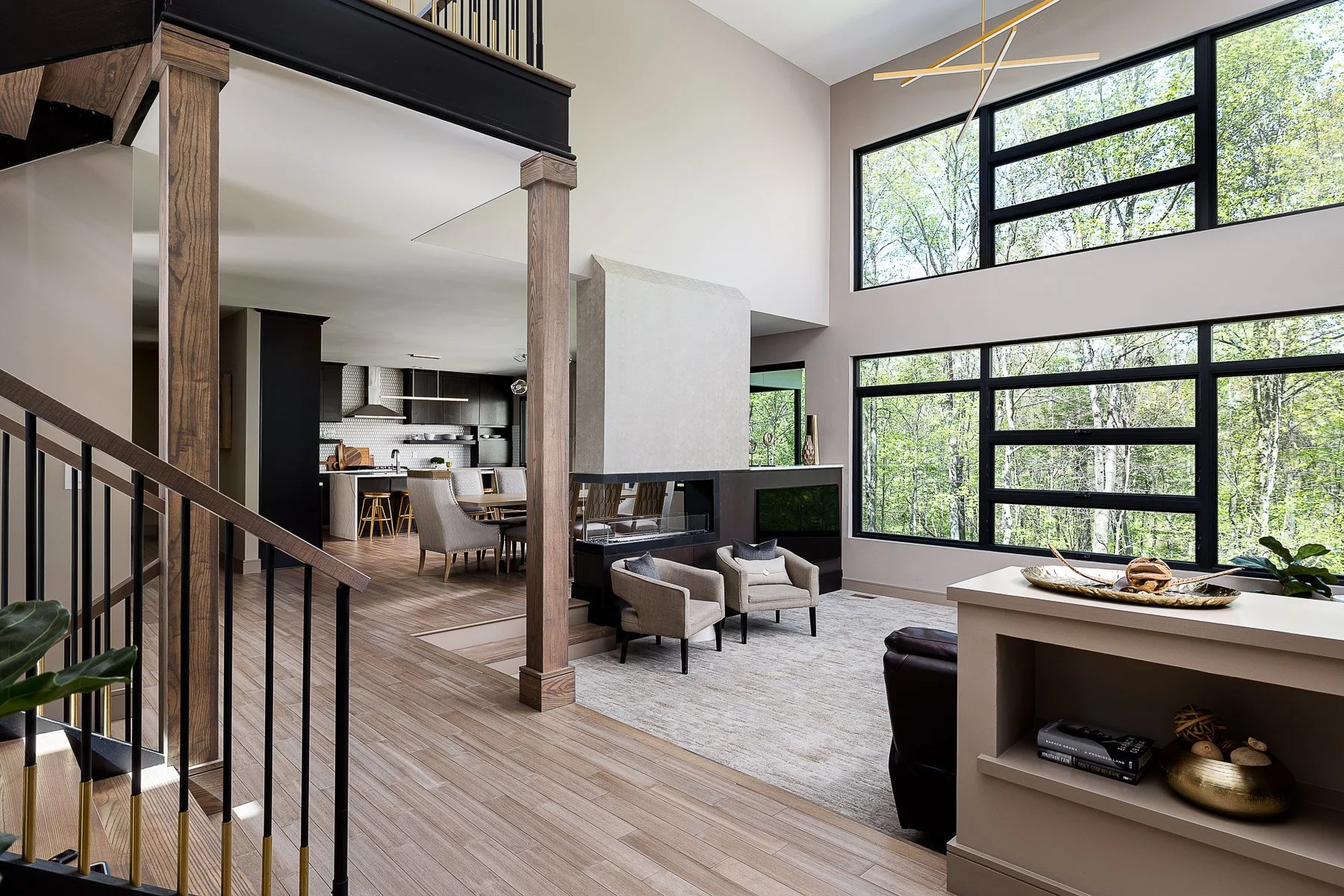
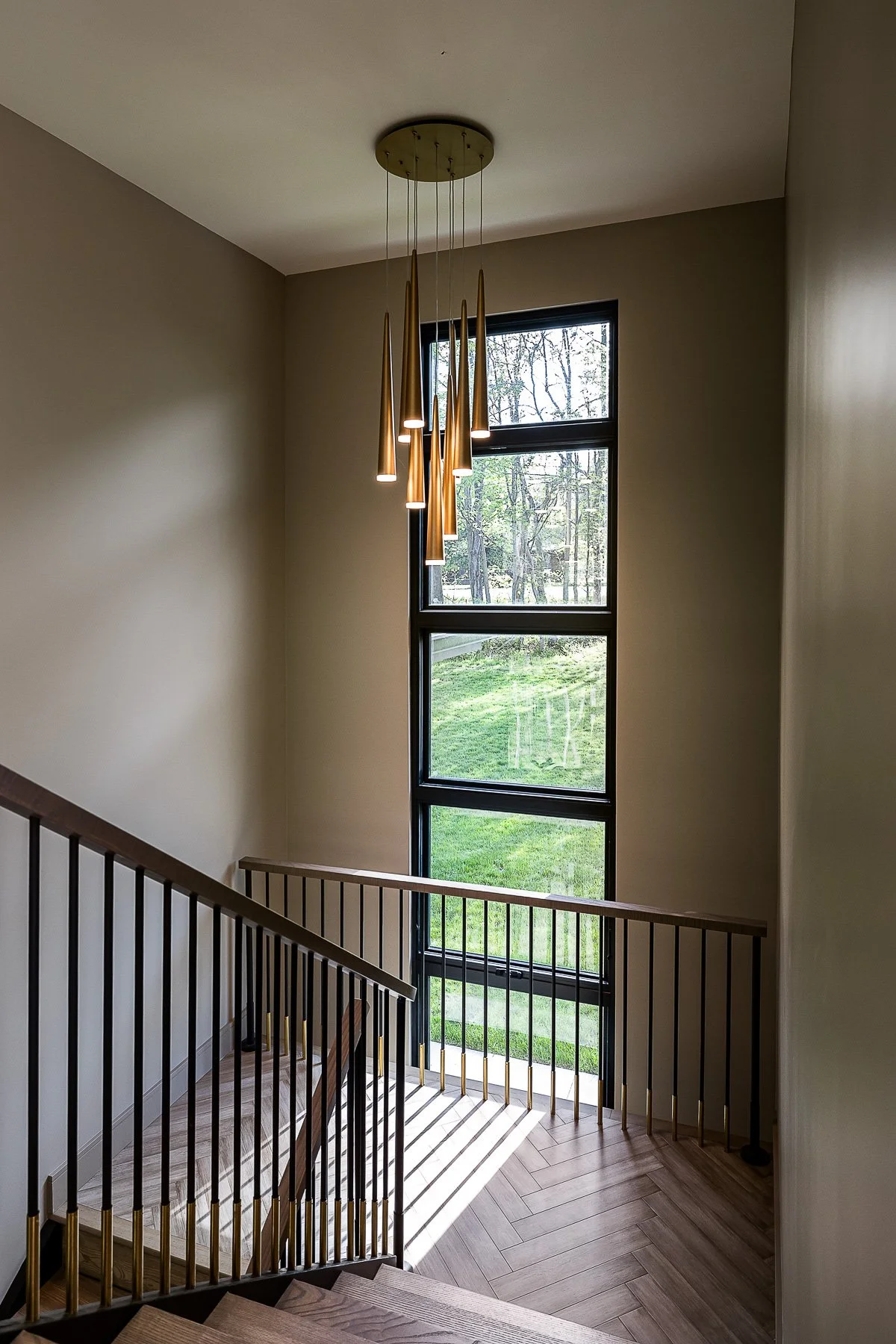
The orientation of the home allows this south facing window to capture the suns movement throughout the day, casting playful shadows and supporting circadian rhythm. The north side of the adjoining family room overlooks the canopy of the wooded lot, allowing the trees and their foliage to also play a role in awareness of time while providing mid grade fractal patterns and unpredictable movement.
From Teenage Designer to Human-Centred Practitioner
Deanna started studying interior design at just 14 years old and graduated from college in 1998. Yet it would take years—and a pivotal phone call—for her work to fully align with its deeper purpose.
“In 2006, I was on a phone call with a young woman who was sharing how her childhood home was no longer a warm and inviting space. It was kind of a sad and sickly structure,” she recalls. There was moisture in the basement, and it had begun to “damage keepsakes”. More concerning was the impact on the woman’s mother, who was experiencing depression and recurring respiratory infections.
“I remember thinking—what came first?” Deanna reflects. “And at the end of the call, I concluded it didn’t really matter.”
What mattered was the relationship between the environment and wellbeing.
“I was convinced that if we were to refresh, renew and revitalise the home, it could only have a positive impact on her mum’s wellbeing,” she explains. “That’s where the philosophy for Tranquil Interiors was born.” From that 2006 phone call onward, her lens shifted.
In 2014, after years working under other organisations, Deanna officially launched Tranquil Interiors LLC to fully practice her human-centred philosophy. “There were times when employers weren’t happy with my sensible approaches,” she admits. “…like you don’t put dust covers on a bed for a child with allergies.”
“I always looked at my projects from an emotional, stress-reducing, life-supporting perspective,” she tells The Biophilic Blueprint. “It’s so important to me that people feel they belong—that they are comfortable, that they can thrive and flourish in the spaces we create—whether it’s a home or a place of business.”
Deanna’s philosophy is deeply informed by research in neuroscience and neuroplasticity—the brain’s remarkable ability to change, heal, and form new connections throughout life. She frequently cites the work of pioneering neuroscientist Dr. Marian Diamond, whose studies in the 1950s challenged the long-held belief that the brain is static and inevitably declines with age.
Diamond studied three groups of rats: one in an enriched environment filled with puzzles, toys and changing stimuli; one in a standard environment; and one in an impoverished setting.
“At the conclusion of the 30-day study, she (Diamond) dissected the brains of the rats,” Girardot explains. “Those in the enriched environment had a six per cent increase in the cerebral cortex—and thicker, richer synaptic connections. Those in the impoverished environment actually had a decrease in brain mass.”
For Deanna, the findings were profound.
“Neuroplasticity—the knowledge that our brains can heal and grow, reconnect and restore—is a beautiful discovery,” she says. “And that knowledge started with environmental factors.”
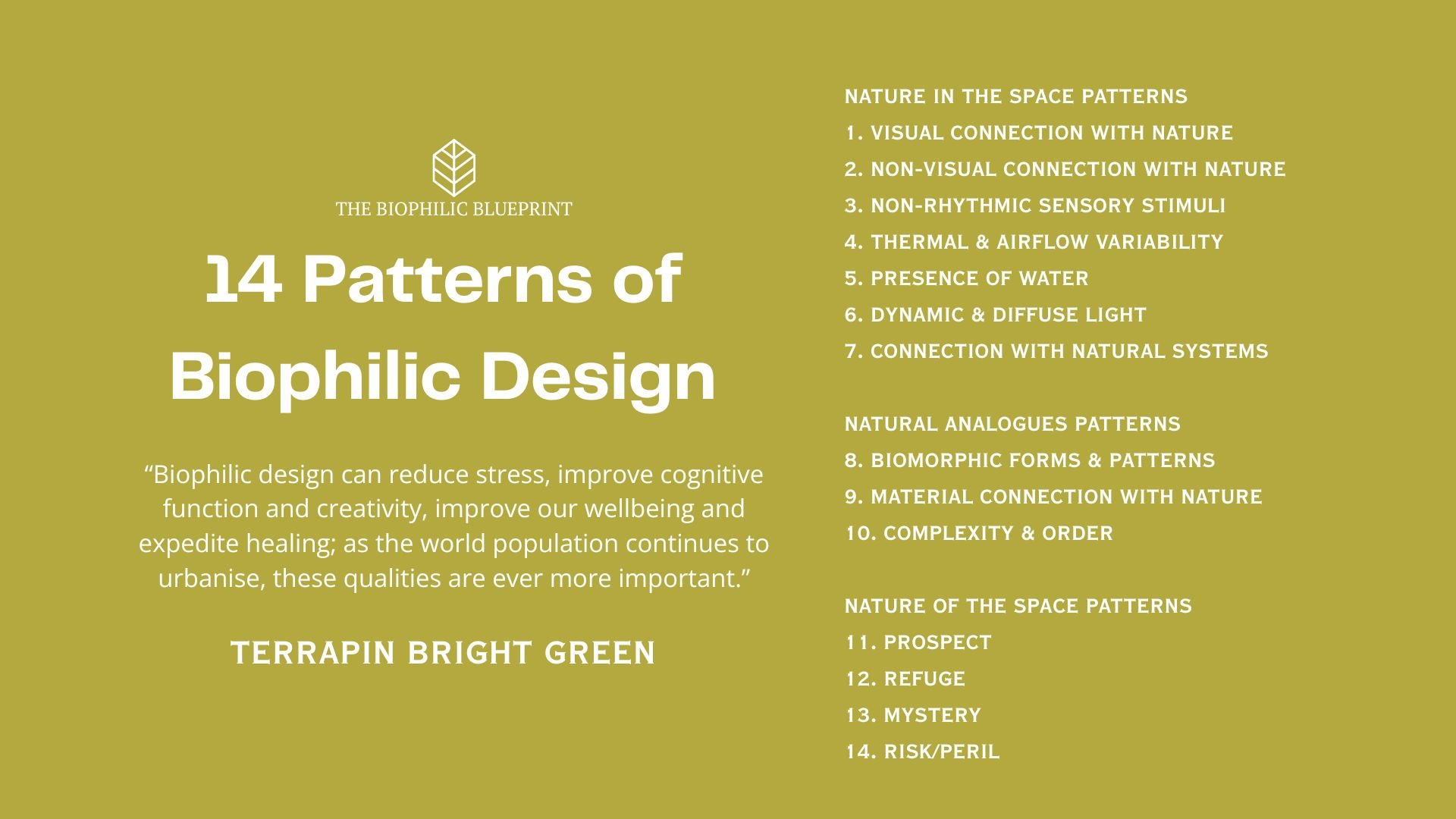
Graphic by The Biophilic Blueprint.
Biophilic Design in Practice: Crafting Healthy Spaces
Deanna applies scientific research alongside biophilic design, which aims to reconnect people with nature through the built environment (Kellert and Calabrese, 2015). Drawing on the work of Bill Browning and Terrapin Bright Green, she evaluates each space through the framework of the 14 Patterns of Biophilic Design, ensuring that every environment supports wellbeing, connection and renewal.
Each space has different physiological demands—and therefore different design priorities. When natural light or views of nature are limited for example, those deficiencies must be consciously addressed. “Is this a space for connection and rejuvenation, or is it task-oriented, like a kitchen or bathroom?” she asks.
For Deanna, the responsibility placed on designers, builders and developers is significant. “There is no such thing as a neutral space,” she says plainly. “Our environments either cause harm—or they allow us to flourish.”
She encourages industry professionals to deepen their knowledge, gain the education and pursue certifications which help them “step up and serve communities fully”, designing spaces that foster a wellbeing and belonging.
From Sameness to Sanctuary: How Spaces Shape Belonging
Deanna explains that a true sense of belonging is often lost when homes or offices are designed without regard for the surrounding place, community, or the people who inhabit them.
She is critical of mass-development housing, where limited choices produce nearly identical environments. “You might see the same house over and over again with slight modifications,” she says. “Inside, they all feel the same.”
Psychologically, this sameness carries consequences. “We know there are consequences to spaces where people don’t feel they belong,” she tells The Biophilic Blueprint. That’s why she relishes the opportunity to design from the ground up in new construction projects, collaborating with clients to create spaces that truly foster a sense of belonging.
For example, Deanna carefully considers natural light and room orientation. She often places children’s bedrooms on the north side of the home, ensuring they neither wake too early with the sun nor struggle to fall asleep during long summer evenings. These subtle choices directly support circadian rhythms and sleep quality, both key pillars of health.
Equally important is the concept of “flow”—how people move through a space and how seamlessly a home supports daily routines. “When a home reflects the occupant authentically, they develop a sense of belonging. They know it’s theirs. It’s as unique as they are,” she notes. Thoughtful design reduces friction in everyday life: “When you can kick off your shoes and not trip over things, life moves more smoothly. Removing these small stressors lowers cortisol and lets people come home, exhale, and feel sanctuary.”
Not all projects offer ideal conditions, but Deanna adapts biophilic principles to meet the challenges. In a recent commercial project—a museum with offices entirely below ground—she explained: “We’re over-exaggerating the lighting. Using dynamic smart lighting programmed to mimic the colour and rhythm of natural daylight.”
By thoughtfully applying biophilic design, Deanna transforms even challenging spaces into environments that nurture wellbeing, productivity and a genuine sense of place.
Nature artwork also becomes critical in these spaces, she adds. “It has to be photo-quality images of nature. And then we layer in texture, shadow and depth to fully support the people working there.”
How It Aligns with The Biophilic Blueprint
Deanna Girardot’s work embodies the core principles of The Biophilic Blueprint: that our built environments are living systems, deeply intertwined with human health, ecological awareness and social wellbeing. Her neuroaesthetic approach reinforces our belief that design is not merely visual—it is biological. That beauty is not superficial, but functional. And that belonging, care and connection must be embedded into the spaces we inhabit every day. By bridging neuroscience, biophilic design and lived human experience, Deanna reminds us that when we design for the unconscious mind, we create environments where people don’t just exist—but truly thrive.
Learn more about the brain and architecture:
Living Future Europe’s Biophilic Society Ambassador Program features a presentation by Don Ruggles exploring the intersection of beauty, neuroscience and architecture. Ruggles is an architect and CEO Emeritus of Ruggles Lindemann Bell, bringing more than 50 years of practice and over 1,000 completed projects across 16 U.S. states and eight countries. He is the author of Beauty, Neuroscience & Architecture: Timeless Patterns & Their Impact on Our Well-Being, a seminal work examining how built form influences human health and perception.
References and further reading
About Deanna Girardot: Deanna Girardot is the founder of Tranquil Interiors LLC, a Michigan-based interior design studio focused on human-centred and biophilic design. She specialises in creating spaces that support wellbeing, flow and a sense of belonging. Learn more at tranquilinteriorsllc.com.
Browning, W. D., Ryan, C. O., & Clancy, J. O. (2014). 14 patterns of biophilic design. Terrapin Bright Green.
Kellert, S. R., & Calabrese, E. F. (2018). Nature by design: The practice of biophilic design. Yale University Press.
Magsamen, S. H. (2019, July 1). Your brain on art: The case for neuroaesthetics. Cerebrum, 2019, cer-07-19. https://www.ncbi.nlm.nih.gov/pmc/articles/PMC7075503/
Rosenzweig, M. R., Bennett, E. L., & Diamond, M. C. (1972). Brain changes in response to experience. Tutor2u Psychology. https://www.tutor2u.net/psychology/reference/rosenzweig-bennett-and-diamond-1972?srsltid=AfmBOopFGs0bmQDS4EzSeHKjGOH7YdeuNronsLq0lQQ0u9Xa8zIpCfYk